
G. R. Desiraju awarded the 14th Ewald Prize
For pioneering the subject of crystal engineering and the supramolecular synthon concept, and for establishing the structural significance of weak hydrogen bonding and halogen bonding in molecular crystals and biology.
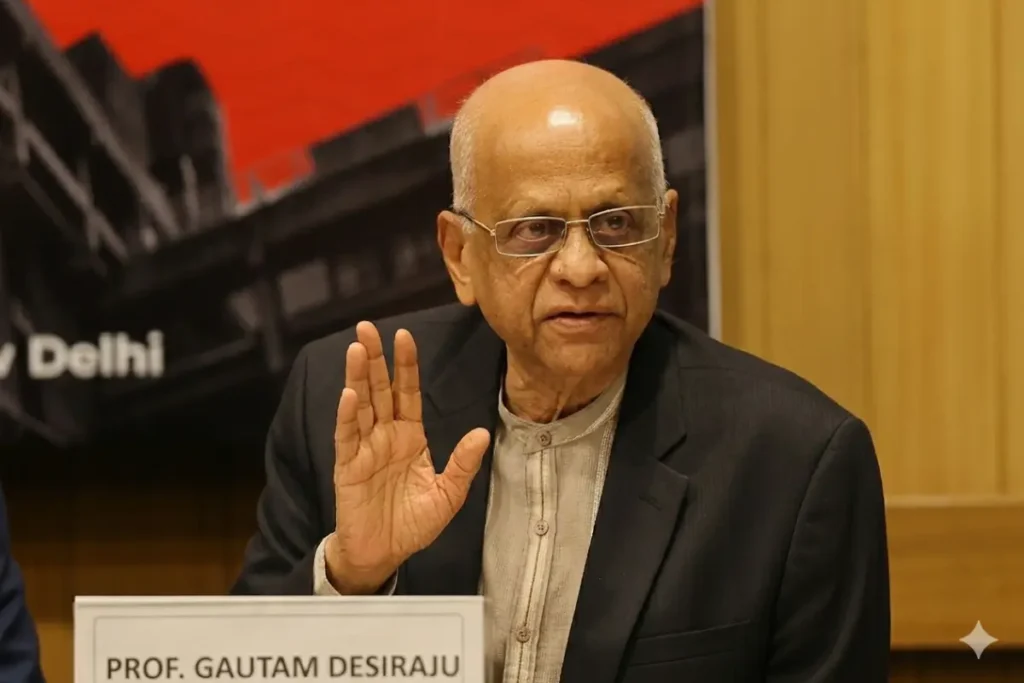
The 14th Ewald Prize is awarded to Professor Gautam R. Desiraju, Professor Emeritus in the Solid State and Structural Chemistry Unit at the Indian Institute of Science, Bengaluru, Distinguished Professor at the University of Petroleum and Energy Studies, Dehradun, Professor at the School of Technology, Rishihood University, Sonipat and Distinguished Professor in the Centre of Indian Knowledge Systems and Mental Health Applications at the Indian Institute of Technology Mandi. He received his PhD from the University of Illinois at Urbana–Champaign in 1976 and, following research at the Eastman Kodak Company, Rochester, returned to India in 1978 to pursue a distinguished academic career spanning the University of Hyderabad and the Indian Institute of Science.
Professor Desiraju is internationally well known for his work on crystal engineering and weak hydrogen bonds and is recognised for establishing crystal engineering as a predictive, design-oriented discipline within structural chemistry. His 1989 monograph, Crystal Engineering: The Design of Organic Solids, provided the first comprehensive, extended definition of the field, framing it as the understanding and application of intermolecular interactions in the strategic design of molecular solids with specific properties.
In 1995, he introduced the concept of the supramolecular synthon, identifying this module, the core of a crystal structure, as a synthetic target, thereby enabling a retrosynthetic approach that has transformed crystal design and become foundational to modern crystal engineering.
He has also played a central role in securing broad acceptance of weak hydrogen bonds—particularly C–H···O interactions—as structurally and functionally significant in both small-molecule crystals and biological systems. His work has extended to halogen bonding and to international standard-setting, including participation in IUPAC groups that formulated definitions of the hydrogen bond, the halogen bond and similar interactions involving electrophilic chalcogen, pnictogen and tetrel atoms.
His later work, both on the supramolecular synthon and weak interactions, reinforces our understanding of the molecular crystal as a complex system, in other words, a holistic crystal.
As the author of more than 475 research papers with over 80,000 citations (h-index approximately 105), Professor Desiraju is among the most highly cited scientists in structural chemistry. His service to the Union includes his presidency of the IUCr from 2011 to 2014 and he has published a Monograph on Crystallography, together with Thomas Steiner, in the IUCr-OUP book series titled “The Weak Hydrogen Bond In Structural Chemistry and Biology”. He is also recognised for his role in activities related to the International Year of Crystallography (IYCr2014) and for its impact on the development of crystallography worldwide, especially in developing countries. Through his research, scholarship and leadership, he has reshaped how crystallographers understand intermolecular interactions and design functional molecular solids.
Professor Desiraju will deliver the Ewald Prize Lecture during the Opening Ceremony of the 27th IUCr Congress on 11 August 2026.
For a list of papers by Professor Desiraju appearing in IUCr journals click here.